






Register to get 2 free articles
Reveal the article below by registering for our email newsletter.
Want unlimited access? View Plans
Already have an account? Sign in
This Monday (March 2nd), Scotland will become the first region of the UK to legalise hydrolysis – often referred as water cremation – under new regulations passed by the Scottish Parliament.
It marks the biggest change in funeral laws since cremation was introduced in 1902, providing families with a third funeral option for the first time. This landmark is momentous and also provides a unique opportunity for funeral directors to be at the forefront of expertly offering hydrolysis.
Although hydrolysis will not initially be available in England and Wales, the change in law in Scotland will provide evidence that it can be regulated and delivered safely in the UK.
The Law Commission is currently considering the provision of new funerary methods in England and Wales and is expected to publish a draft bill shortly. The bill will provide a legislative framework for all new funeral methods and could pave the way for the development of regulations to allow hydrolysis in the rest of the UK.
So what are the practical implications for funeral directors in Scotland and how will this impact the rest of the UK?
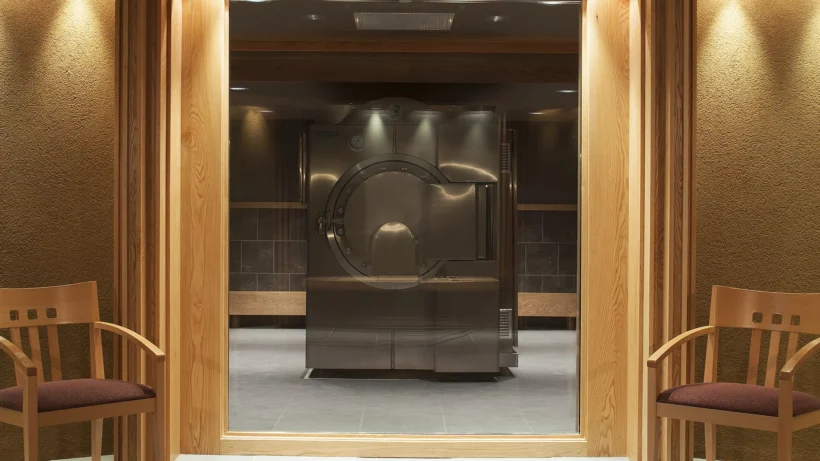
Firstly, a quick recap on the basics of hydrolysis. The deceased is wrapped in a biodegradable material and placed in a pressurised chamber, which is sealed and 95% water and 5% alkaline solution is added. It is then heated to a maximum 150C and, over three to four hours, the body is broken down and reduced to its basic elements, in a similar way to burial, but in a much shorter time.
The alkaline helps speed up a process that would normally happen naturally after burial.
The liquid is cooled, treated and then discharged to the wastewater system, where it is processed by water companies in the usual way. It contains no solids, is sterile, and contains no DNA. Discharge can only take place with a permit from the relevant water authority, in this case Scottish Water.
After the process is complete, the remaining soft bones are dried, cooled and reduced to a fine white powder. These are returned to the family in an urn or container of their choice, in the same way as ashes following cremation. Families can choose to scatter, bury or keep the powder remains.
Kindly Earth, where I am general manager, is already in discussions with several Scottish funeral directors and crematoria interested in offering the service. It is working in partnership with Resomation Ltd, the UK manufacturer of hydrolysis equipment.
Now that the legal framework is in place, it is expected to take six to nine months before the first Scottish facility is operational, as crematoria or funeral operators will need to secure planning permission and obtain a “Consent to Discharge” from their local water authority.
There is precedence: Resomation Ltd has installed hydrolysis systems around the world across more than a decade, including in the US (where it is legal in 28 states), Canada, Ireland, South Africa, Australia and New Zealand. Desmond Tutu chose water cremation for his funeral arrangements in 2022.
From experience in other countries, we already know that what matters most is the way in which funeral directors offer hydrolysis to their clients – either when they are arranging a funeral or planning ahead for a future funeral.
Not everyone will choose hydrolysis, of course – and that’s the point. It’s about giving families more choice. Each family has different values and priorities. Some people, for example, are looking for options that feel more aligned with their environmental concerns. Hydrolysis can meet that objective, producing no direct toxic emissions to air. Many families choosing it say they do so as it feels “gentler”.
Cremation and burial are well understood by the public, having been the two funeral choices available for so long. With the introduction of hydrolysis comes the opportunity for funeral directors to prepare their teams to confidently explain the service and answer those all important questions which clients will have. Funeral directors shouldn’t be expected to navigate a new process on their own. Kindly Earth has years of experience in the sector and can provide practical guidance, clear written materials and access to training to support funeral directors every step of the way.
In the early days of adoption of hydrolysis in the UK, clients will need clear information to allow them to make a fully informed choice.
Funeral directors understand so well the need for sensitivity and care when supporting bereaved families. Each person’s needs are unique and must be met in a way which is personalised to them. Reassurance is key.
As hydrolysis becomes available, it is that skill of ensuring the service is fully understood whilst not sounding overly “technical” which will make such a difference.
For now, hydrolysis will only be regulated in Scotland. In England and Wales, the Law Commission report on new funerary methods is due to be published in the next few months. In the meantime, it may be that clients from England and Wales will choose hydrolysis when arranging a funeral.
It’s prudent for funeral directors south of the border to also prepare and arm themselves with knowledge, for which Kindly Earth is able to assist.